


Feeling the pinch of rising prices.
The cost of living is increasing in many places around the world. “The war has sent oil prices soaring and led to shortages of products like jet fuel. Coal prices have also risen as some power companies switch to coal from natural gas to generate electricity. Countries that depend on other fuel sources—from renewables to nuclear power—have been spared some of the economic hardship so far,” reported Avi Salzman of Barron’s
In April, prices in the United States rose at an annual rate of 3.8 percent, with energy prices up 17.9 percent year over year. That was a significant increase from the prior month when prices rose at an annual rate of 3.3 percent, with energy prices rising at a 12.5 percent pace.
For Americans, higher prices have been especially noticeable at the gas pump.
Last Saturday, the average price for regular gasoline was $4.53 per gallon in the United States, and the price of diesel (used by long-haul trucks moving goods across the U.S.) was $5.63 per gallon, according to AAA. Overall, estimates suggest that Americans have spent an extra $20 billion on gasoline due to the war with Iran, reported Enda Curran, Mark Schroers, Ye Xie, and Jorgelina Do Rosario of Bloomberg.
Americans are not feeling optimistic
When economists want to know how people feel about their personal financial situations and the economy in general, they look at consumer sentiment. In May, the University of Michigan’s Index of Consumer Sentiment dropped, reflecting continued concerns about the economy and what may happen over the next year.
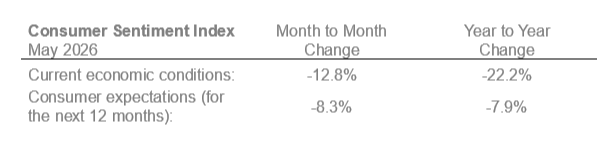
“Sentiment is now just below the previous historical trough seen in June 2022. The cost of living continues to be a first-order concern, with 57 [percent] of consumers spontaneously mentioning that high prices were eroding their personal finances, up from 50 [percent] last month,” wrote Surveys of Consumers Director Joanne Hsu.
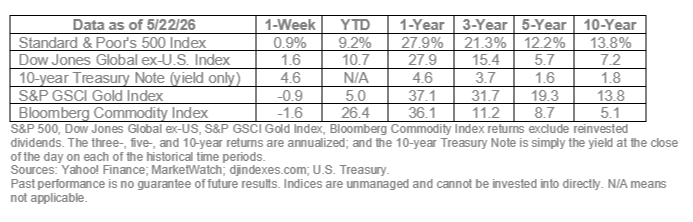
Last week, solid company earnings and signs of progress toward an agreement with Iran pushed major U.S. stock indexes higher for the eighth week in a row, reported Karishma Vanjani of Barron’s. Yields on U.S. Treasuries eased a bit last week.
WHAT DO YOU KNOW ABOUT AMERICA’S MONEY MOOD? While U.S. consumer sentiment is lower overall, not every American household experiences the economy the same way. Some families are stretching to cover basic expenses, while others are buoyed by strong investment returns. Test your knowledge by taking this brief quiz.
1. According to a recent Gallup poll, what financial issue did Americans say was the top problem facing their families this year?
a. Student loan payments
b. Cost of living/inflation
c. Lack of retirement savings
d. Credit card debt
2. Seventy-three percent of Americans describe one issue as a “very big problem” in a recent Pew Research Center survey. What was it?
a. Unemployment
b. Artificial intelligence
c. Healthcare affordability
d. Stock market volatility
3. Americans experience the economy differently depending on their income level. Teresa Rivas of Barron’s wrote that one factor has helped bolster the finances of many higher-income households. What factor was it?
a. Lower mortgage rates
b. Falling healthcare costs
c. Stock market performance
d. Reduced grocery prices
4. According to a recent Gallup survey, what percentage of Americans are moderately or very worried they won’t have enough money for retirement?
a. 30 percent
b. 48 percent
c. 62 percent
d. 87 percent
WEEKLY FOCUS – THINK ABOUT IT
“In the history of art there are periods when bread seems so beautiful that it nearly gets into museums.”
― Janet Flanner, Journalist
Answers: 1) b; 2) c; 3) c; 4) c
Securities offered through LPL Financial, Member FINRA/SIPC.
* These views are those of Carson Coaching, not the presenting Representative, the Representative’s Broker/Dealer, or Registered Investment Advisor, and should not be construed as investment advice.
* This newsletter was prepared by Carson Coaching. Carson Coaching is not affiliated with the named firm or broker/dealer.
* Government bonds and Treasury Bills are guaranteed by the U.S. government as to the timely payment of principal and interest and, if held to maturity, offer a fixed rate of return and fixed principal value. However, the value of fund shares is not guaranteed and will fluctuate.
* Corporate bonds are considered higher risk than government bonds but normally offer a higher yield and are subject to market, interest rate and credit risk as well as additional risks based on the quality of issuer coupon rate, price, yield, maturity, and redemption features.
* The Standard & Poor's 500 (S&P 500) is an unmanaged group of securities considered to be representative of the stock market in general. You cannot invest directly in this index.
* All indexes referenced are unmanaged. The volatility of indexes could be materially different from that of a client’s portfolio. Unmanaged index returns do not reflect fees, expenses, or sales charges. Index performance is not indicative of the performance of any investment. You cannot invest directly in an index.
* The Dow Jones Global ex-U.S. Index covers approximately 95% of the market capitalization of the 45 developed and emerging countries included in the Index.
* The 10-year Treasury Note represents debt owed by the United States Treasury to the public. Since the U.S. Government is seen as a risk-free borrower, investors use the 10-year Treasury Note as a benchmark for the long-term bond market.
* Gold represents the 3:00 p.m. (London time) gold price as reported by the London Bullion Market Association and is expressed in U.S. Dollars per fine troy ounce. The source for gold data is Federal Reserve Bank of St. Louis (FRED), https://fred.stlouisfed.org/series/GOLDPMGBD228NLBM.
* The Bloomberg Commodity Index is designed to be a highly liquid and diversified benchmark for the commodity futures market. The Index is composed of futures contracts on 19 physical commodities and was launched on July 14, 1998.
* The DJ Equity All REIT Total Return Index measures the total return performance of the equity subcategory of the Real Estate Investment Trust (REIT) industry as calculated by Dow Jones.
* The Dow Jones Industrial Average (DJIA), commonly known as “The Dow,” is an index representing 30 stock of companies maintained and reviewed by the editors of The Wall Street Journal.
* The NASDAQ Composite is an unmanaged index of securities traded on the NASDAQ system.
* International investing involves special risks such as currency fluctuation and political instability and may not be suitable for all investors. These risks are often heightened for investments in emerging markets.
* Yahoo! Finance is the source for any reference to the performance of an index between two specific periods.
* The risk of loss in trading commodities and futures can be substantial. You should therefore carefully consider whether such trading is suitable for you in light of your financial condition. The high degree of leverage is often obtainable in commodity trading and can work against you as well as for you. The use of leverage can lead to large losses as well as gains.
* Opinions expressed are subject to change without notice and are not intended as investment advice or to predict future performance.
* Economic forecasts set forth may not develop as predicted and there can be no guarantee that strategies promoted will be successful.
* Past performance does not guarantee future results. Investing involves risk, including loss of principal.
* The foregoing information has been obtained from sources considered to be reliable, but we do not guarantee it is accurate or complete.
* There is no guarantee a diversified portfolio will enhance overall returns or outperform a non-diversified portfolio. Diversification does not protect against market risk.
* Asset allocation does not ensure a profit or protect against a loss.
* Consult your financial professional before making any investment decision.
Sources:
https://www.barrons.com/articles/renewable-solar-energy-iran-war-bb3f0249? or go to https://resources.carsongroup.com/hubfs/WMC-Source/2026/05-26-26-Barrons-Renewable-Energy-Is-Booming%20-%201.pdf
https://www.bls.gov/news.release/cpi.nr0.htm
https://www.bls.gov/news.release/archives/cpi_04102026.htm
https://gasprices.aaa.com or go to https://resources.carsongroup.com/hubfs/WMC-Source/2026/05-26-26-AAA-Fuel-Prices%20-%204.pdf
https://www.bloomberg.com/news/features/2026-05-21/iran-war-upends-inflation-bets-in-50-trillion-debt-market-safe-haven or go to https://resources.carsongroup.com/hubfs/WMC-Source/2026/05-26-26-Bloomberg-50-Trillion-Safe-Haven%20-%205.pdf
https://www.sca.isr.umich.edu or go to https://resources.carsongroup.com/hubfs/WMC-Source/2026/05-26-26-U-of-M-Survey-of-Consumers%20-%206.pdf
https://www.barrons.com/livecoverage/stock-market-news-today-052226/card/the-dow-notches-a-record-high-as-s-p-500-rises-for-eight-straight-weeks-u6jG2KGhKEoN5psACDZP or go to https://resources.carsongroup.com/hubfs/WMC-Source/2026/05-26-26-Barrons-The-Dow-Posts-a-Record%20-%207.pdf
https://news.gallup.com/poll/708905/affordability-dominates-americans-financial-worries.aspx
https://www.barrons.com/articles/consumer-sentiment-lower-income-shoppers-gas-prices-872889bc or go to https://resources.carsongroup.com/hubfs/WMC-Source/2026/05-26-26-Barrons-Americas-Consumer-Divide%20-%2011.pdf